AEO (Answer Engine Optimization) and voice search are changing how people find local businesses, often answering questions directly on the results page instead of sending someone to a website. This means local rankings now depend on more than just an updated Google Business Profile and a handful of keywords. Below, we break down what has actually changed, what still matters, and how a local business can adjust without starting from scratch.
What Is AEO and How Does It Work?
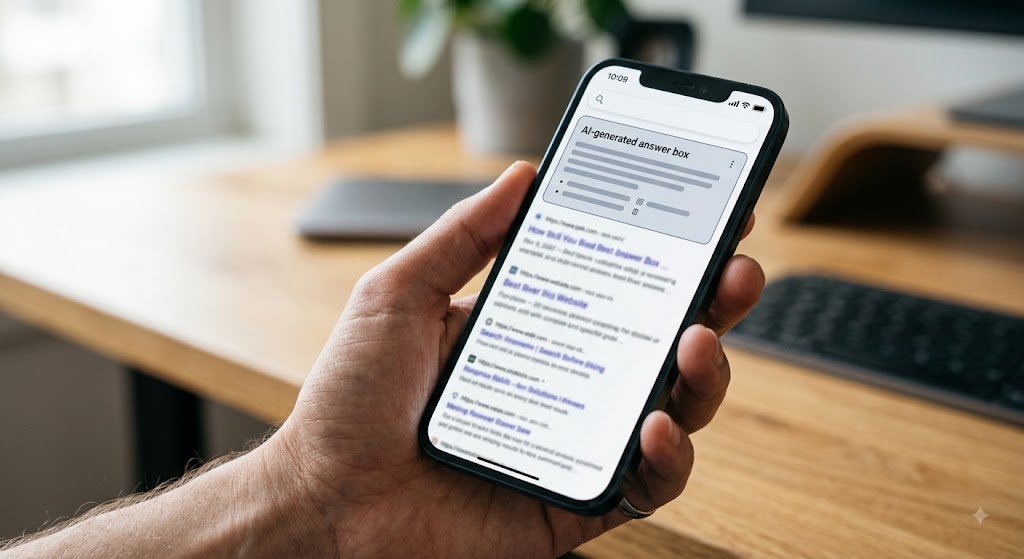
AEO is the practice of optimizing content to show up in AI-generated answers, like the summary that appears at the top of many Google search results. That summary pulls information from several sources to answer a question before a person even clicks on a website. It shows up for a large share of searches now, including many local ones like “best plumber near me” or “coffee shop open late.”
AEO favors content that answers a question clearly and quickly over pages packed with keywords but light on real information. For a local business, that means the old approach of stuffing a page with a city name over and over does far less than it used to.
Why Local Businesses Are Seeing Fewer Clicks From Search
Many local businesses have noticed fewer visitors coming from Google even though their rankings look fine, and AEO is a big part of the reason. When an overview already answers the searcher’s question, like hours of operation or a general price range, there is less reason for that person to click through to an actual website.
This shift affects some types of searches more than others:
- Simple factual questions (hours, phone numbers, basic pricing) get answered directly through AEO most often
- Comparison searches (“best,” “top rated,” “near me”) still tend to drive clicks, since people want to see options for themselves
- Searches involving a purchase decision or booking still usually lead to a website visit or a call
Businesses that rely mostly on simple factual searches for traffic are the ones feeling this shift the most.
How Voice Search Changes What People Ask
Voice search tends to use longer, more conversational phrases than typed search, since people talk differently than they type. Someone typing might search “pizza Columbus Nebraska,” while someone using voice search on their phone is more likely to ask “where can I get pizza delivered near me right now.”
This shift toward natural, conversational phrases means content written in a natural, question and answer style tends to perform better than content built around short, choppy keyword phrases. A local business page that directly answers a real question, like what areas it delivers to or whether it takes walk ins, has a better shot at matching how people are actually asking questions out loud.
What Google Still Uses to Decide Local Rankings
Despite all the AI changes, local rankings still come down to three core factors: relevance, distance, and prominence. Relevance means how well a business matches what someone is searching for, distance is how close the business is to the searcher, and prominence covers how well known and well reviewed the business is.
None of that has gone away with AEO. If anything, prominence matters more now, since AI systems tend to pull from businesses that already have strong review counts, consistent information across the web, and an active online presence. A business with outdated hours listed on Google, a different address on Facebook, and no reviews in the last year is working against itself before AI even enters the picture.
How to Show Up in AEO Results
Getting pulled into AEO results usually comes down to having clear, direct answers to common questions somewhere Google can find them, whether that is your website, your Google Business Profile, or a review platform. The businesses that show up most often are the ones that make it easy for an AI system to find a clean answer.
A few practical steps that help:
- Answer common customer questions directly on your website in plain language, not buried in long paragraphs
- Keep your Google Business Profile filled out completely, including hours, services, and photos
- Respond to reviews, since AI systems often reference review content when building an answer
- Keep your business information (name, address, phone number) identical across every platform you appear on
One detail many business owners miss is that AI systems tend to favor specific, detailed answers over general marketing language. A page that says “we offer fast, friendly service” gives an AI system nothing useful to pull from. A page that says exactly what services are offered, what areas are covered, and what a typical appointment looks like gives it something concrete to work with. The more specific the information, the easier it is for that information to end up in front of a searcher.
Why Google Business Profile Matters More Than Ever
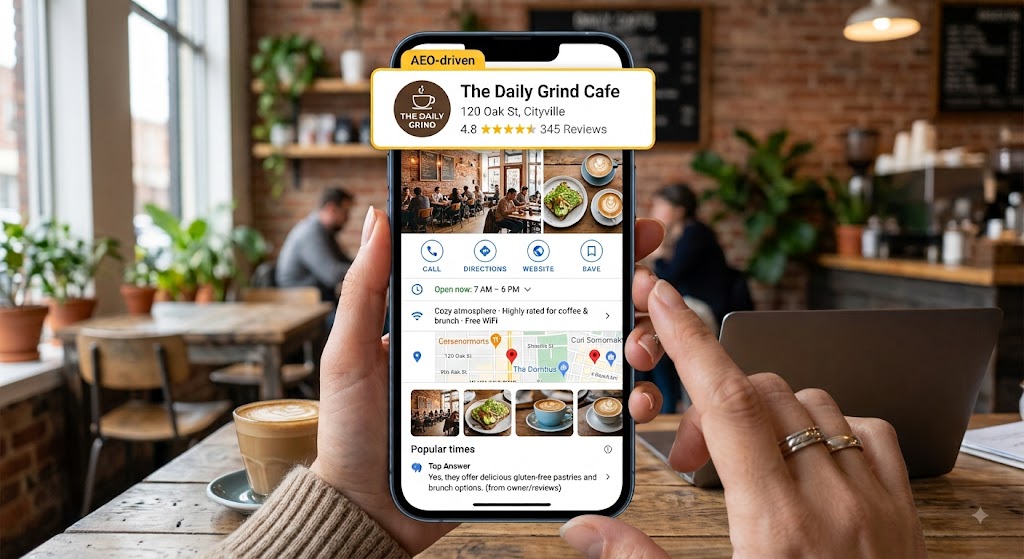
A complete, active Google Business Profile is one of the strongest signals a local business has for both traditional rankings and AEO results, since it is a direct source Google trusts for accurate business information. Businesses that treat their profile as a “set it and forget it” listing are missing a real opportunity here.
Profiles that get updated regularly, with new photos, accurate hours, and posts about specials or events, tend to perform better than ones left untouched for months. This is one of the most overlooked parts of local search. A business can have a great website and still lose visibility simply because its Google Business Profile has not been touched since it was created. We manage this directly for clients through our Google Business Profile and local SEO services, keeping the profile active instead of letting it sit stagnant.
How Paid Ads Fit Into an AEO Driven Search World
Paid search ads still appear above both AEO results and organic results in most cases, making them one of the more reliable ways to stay visible while search results keep shifting. For businesses feeling the impact of fewer organic clicks, ads can fill that gap while other strategies catch up.
This does not mean paid ads replace everything else, but they do give a business a guaranteed spot at the top of the page while organic visibility adjusts to these changes. Combining strong Google Business Profile management with a Google Ads campaign tends to work better right now than relying on either one alone, since one covers the immediate visibility and the other builds long term presence.
Content Habits That Help With AI Search
Content written to answer specific, real questions tends to perform better in AI driven search than content written mainly to include keywords. Search systems, whether traditional or AI powered, are getting better at telling the difference between genuinely useful information and pages built just to rank.
A few habits worth building into your content:
- Write in a natural, conversational tone that matches how people actually ask questions
- Break information into clear sections with headings, since this makes it easier for both readers and AI systems to pull direct answers
- Keep information current, since outdated pricing or service details can work against you
- Include specific details about your services and area instead of vague, generic descriptions
A well built business website that follows these habits gives both search engines and AI systems more to work with than a generic template site.
It also helps to think about content in terms of the actual questions customers ask before they call or visit, rather than the terms a business owner might use internally. A landscaping company might describe its work as “full property maintenance,” but a customer searching is more likely to type or say something like “who mows lawns near me” or “do you handle leaf cleanup in the fall.” Writing content that mirrors real customer language, alongside the more formal service descriptions, gives search systems more ways to match a business to the right search.
Common Mistakes Businesses Make Adjusting to AI Search
The biggest mistake businesses make right now is assuming AEO means SEO no longer matters, when the truth is closer to the opposite. AI systems still rely on the same signals search engines have always used, they just organize and present that information differently.
Another common mistake is chasing every new AI search trend without fixing the basics first. A business that has not claimed its Google Business Profile, has inconsistent contact information across the web, or has not asked for a review in over a year will not see much benefit from advanced content strategies until those foundational pieces are handled. AI search rewards businesses that already have their information organized and accurate, not businesses trying to game a new system.
What This Means Going Forward
The businesses that will keep showing up in local search, AI powered or not, are the ones with accurate, complete, and consistent information across their website, their Google Business Profile, and review platforms. AEO and voice search have changed how answers get presented, but they have not changed what makes a business trustworthy in the eyes of a search engine.
For a business in Columbus, Nebraska or anywhere else, the plan going forward is less about chasing every new AI feature and more about getting the fundamentals right: clear information, active profiles, real reviews, and content that answers actual questions. Businesses that build on that foundation now will be in a stronger position no matter how search results keep changing.
Frequently Asked Questions
Does AEO mean SEO is no longer necessary?
No, SEO is still necessary since AEO pulls its information from the same types of sources that traditional search rankings have always relied on. Businesses with strong SEO fundamentals are more likely to be included in AI generated answers, not less.
How do I know if AEO is affecting my business?
A drop in website clicks despite stable or improving search rankings is often a sign that AEO is answering searcher questions before they reach your site. Checking search performance reports for a rise in impressions alongside a drop in clicks can help confirm this.
Does voice search require a different website than regular search?
No, a website does not need to be rebuilt for voice search specifically, but content written in a natural, question and answer format tends to perform better for both voice and AI driven search. The same content improvements that help with AEO also help with voice search.
Should I stop investing in Google Ads if AEO is taking clicks?
No, Google Ads still place a business above both AEO results and organic results in most searches, making paid visibility more valuable while organic click through rates shift. Many businesses are using ads to hold visibility while they build up their organic and AI search presence.
How often should I update my Google Business Profile?
A Google Business Profile should be checked and updated at least monthly, with hours, photos, and posts kept current, since inactive profiles tend to lose visibility over time. Businesses experiencing seasonal changes in hours or services should update their profile as soon as those changes happen, not weeks later.
Getting Started With a Local Search Strategy That Works
Search is changing quickly, but the businesses adapting well are not chasing every new AI feature, they are making sure their basic information is accurate, active, and consistent everywhere it appears. That foundation matters more now than ever, not less.
VRLY Media works with businesses across Columbus, Nebraska and beyond to manage exactly these pieces, from Google Business Profile upkeep to paid ad campaigns to website content built around real customer questions. We keep track of how search keeps changing so business owners do not have to, and we build strategies that hold up whether someone finds you through a traditional search, an AEO result, or a voice assistant. If you want a clear look at where your business stands in local search right now, reach out to us here and we will walk you through it.